
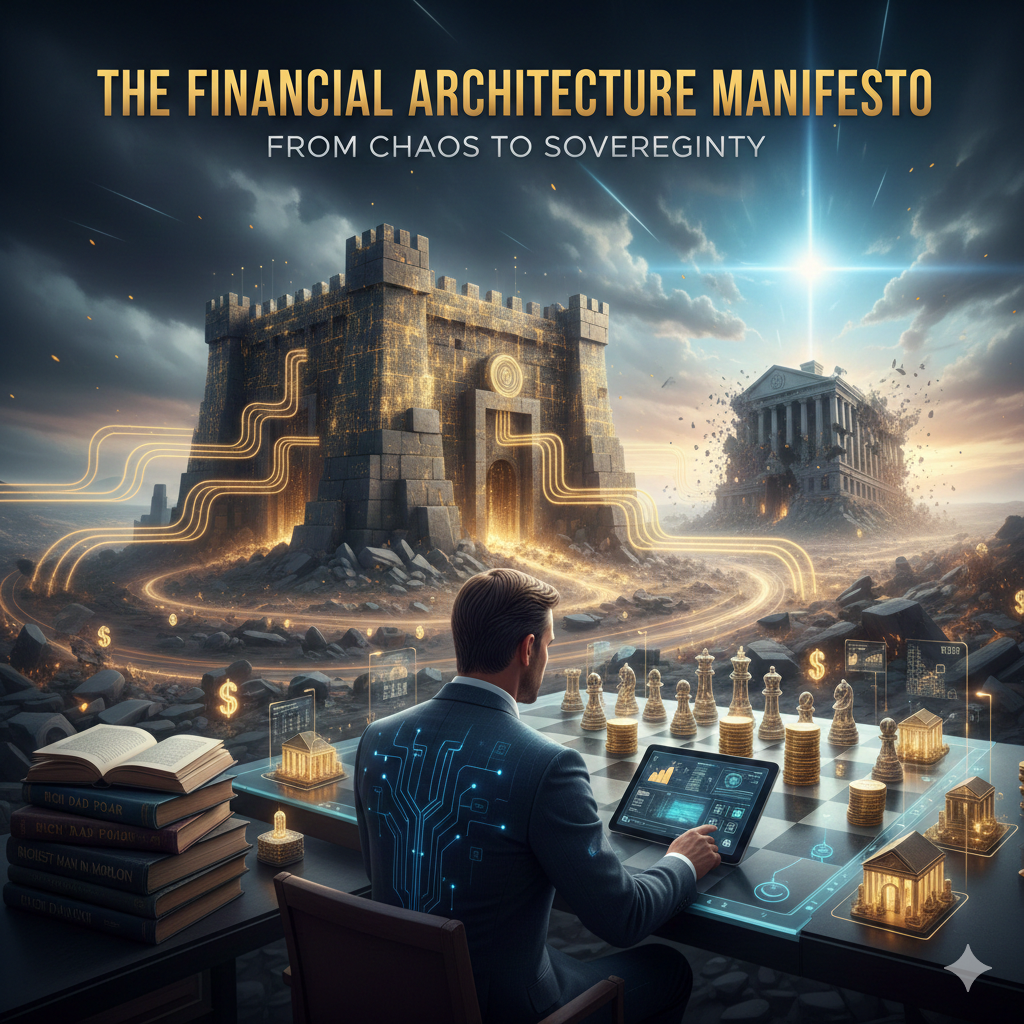
I. The Philosophy: Why “Working Harder” is a Trap
Most people are stuck in a cycle of “Reactive Earning.” They believe the myth that if their salary doubles, their problems will vanish. The truth is harsher: without structure, a higher income only increases the speed at which you sink. You must understand the concept of the Digital Mirage – the modern banking system is not a vault; it is a debt market. To survive this environment, you must stop being a “customer” and start being the “Architect.” This means moving from reacting to bills to designing capital.
II. The Intellectual Foundation: Books That Build the Mind
Before you can change the numbers in your bank account, you must upgrade the “software” in your head. In my Toolbox, I prioritize knowledge over noise. I am including here several books that serve as the “bible” of financial architecture and can be found there:
- “Rich Dad Poor Dad” by Robert Kiyosaki: The foundation that teaches the difference between an asset and a liability. Without this, you are building your house on shifting sands. It is the first step in realizing that your home is often a liability, not an asset.
- “The Psychology of Money” by Morgan Housel: This book proves that financial success isn’t about math; it’s about behavior. It explains why smart people make terrible decisions and how to avoid emotional traps.
- “The Richest Man in Babylon” by George S. Clason: Timeless laws of money told through ancient parables. It is proof that the rules of wealth haven’t changed in millennia – only the tools have.
These books are the intellectual software required to recognize economic traps before you fall into them.
III. Phase 1: Psychological Detox (The Reality Check)
Before you build, you must clear the debris of false beliefs and social myths.
- The Illusion of Home: In the article “The Blood Price of the Illusion of Home,” we examine why a mortgage is often an anchor keeping you chained to a job you hate, rather than an asset making you free.
- The Lesson of Failure: In “The Price of Chaos,” I share my personal story – how losing $1,000 taught me that emotion and “quick wins” are the greatest enemies to your family’s future.
IV. Phase 2: The Command Center (The Dashboard)
Now we move to the engineering. You cannot manage what you do not measure. My Financial Dashboard is designed to be your cockpit.
- The Trial Version: Created for those just starting. it removes the noise and teaches you the most vital skill—identifying the “leaks” in your budget. This is your training ground where you build the habit without pressure.
- The Original (Full Version): The final structure for professionals. It includes long-term planning, investment flow tracking, and true sovereignty. This is the software for those who have decided to stop playing small and want to see the “Grandmaster” view of their wealth.

V. Phase 3: Professional Tools (The Toolbox)
Once the foundation is set and the mind is prepared, you need professional-grade tools to operate effectively in the global market:
- Wise: Forget traditional banks and their hidden fees. Wise is the tool I use to operate in different currencies at the real market rate. This is your sovereignty over transactions and your way to stop paying the “ignorance tax.”
- TradingView: These are your “eyes” on the market. Here, analysis defeats emotion. We use it not for gambling, but for strategic positioning and tracking the assets we choose to own.
VI. The Sequence: How to Build Your Fortress
Do not try to conquer the mountain all at once. Architecture takes time. Follow this algorithm:
- Inform Yourself: Read the articles on the Digital Mirage and The Price of Chaos. Understand the risks.
- Educate Yourself: Pick one book from the list above and start thinking like a capital owner.
- Test the System: Start with the Trial Version of the Dashboard. Just begin observing your flows without judgment.
- Upgrade: Once you feel control over your daily finances, move to the Original Dashboard and optimize your global transactions via Wise.
Conclusion: Be the Architect, Not the Passenger
Financial freedom is not an event (like winning the lottery); it is a process of daily engineering. You are either the Architect of your life, or you are part of someone else’s blueprint.
Stop guessing. Start building.
Leave a Reply